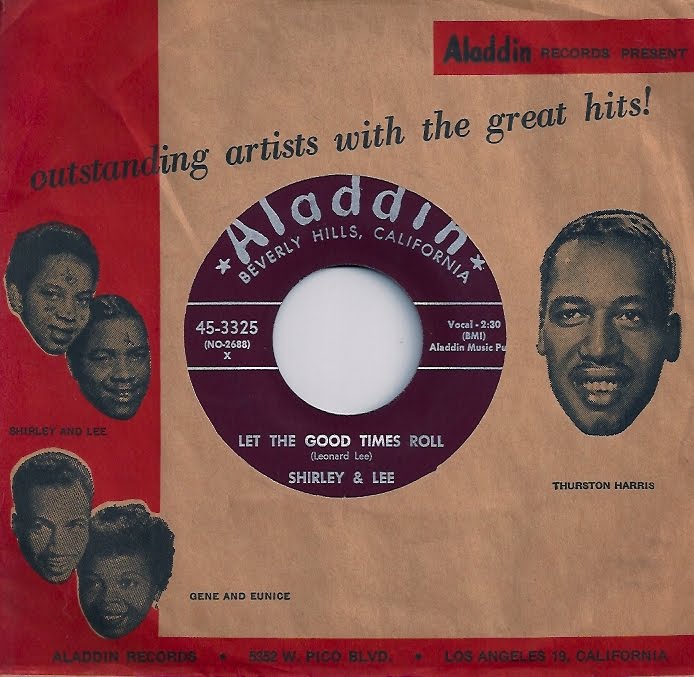
Let The Good Times Roll


[This happy new year's post comes to us from TNOP's UK music correspondent Miles Gallagher.]here are the dozen from 2010 ranked most played to least played - just click on the song title to listen!
if nothing else don't miss the video for number 11 ( unfortunately, as far as i can tell its available on video only )2 loving cup (alternate take) - the rolling stones - exile on main street (deluxe version, remastered)

California Sun
Seven Nights To Rock
"I suppose I’ve always done my share of crying, especially when there’s no other way to contain my feelings. I know that men ain’t supposed to cry, but I think that’s wrong. Crying’s always been a way for me to get things out which are buried deep, deep down. When I sing, I often cry. Crying is feeling and feeling is being human. Oh yes, I cry."
—Ray Charles
Anybody that has spent time in a bar knows that the place isn't always hoppin'. And these are the times that the jukebox can come in handy, especially late at night when loneliness and brooding can set in after a few drinks.
That's why the classic Ray Charles tune "Drown In My Own Tears" is a natural for the TNOP Ultimate Singles Jukebox. A number one hit on the R&B chart in early 1956, Brother Ray's treatment of Henry Glover's song melds the formula that literally gave birth to soul: the swaying gospel beat with the intimate tale of secular problems.
In the intriguing liner notes written by Robert Palmer for the Atlantic compilation Ray Charles: The Complete Atlantic Rhythm & Blues Recordings , 1952-1959, it is noted that even though the rock and roll wave had broken through to white audiences (Elvis Presley had covered Charles' "I Got A Woman"), "at this crucial junction in Charles' career, a very surprising thing happened. Charles refused to compromise his music with the simpler beat, more adolescent lyrics, and smoother singing that white rock and roll fans seemed to favor. He continued to write, arrange, play and sing from his soul, and his records continued to sell almost exclusively within the black community. Even more remarkably, Atlantic an enlightened company but one that needed to sell records as much as any other label, backed Charles all the way. His music suffered no delusion. In fact, mid-fifties Charles landmarks like . . . "Drown In My Own Tears" . . . . recorded during rock and roll's breakthrough period in 1955, was more soulfully incendiary, churchy and rootsy -- more "black" if you will -- than . . . his earlier discs."
Henry Glover's composition, written in 1951 and originally recorded by Lula Reed on King Records, became a classic and constant in the Ray Charles canon throughout the remainder of his career. The stunning backup of The Cookies near the end of the tune's arrangement led Charles to permanently integrate female singers into his act and many of his recordings (the most famous being The Raelettes).
Provided below is a 1986 live performance of "Drown In My Own Tears." Charles is joined on stage by Ron Wood on guitar, Paul Shaffer on organ and Steve Jordan on drums.
I Can't Get Next To You


Here's an irresistible pop confection that hit the charts hard in the UK but only made a blip in the States. 4hero is an electronic music collective from North London that has been producing records since the late 1980s. The leaders are Mark "Marc Mac" Clair and Dennis "Dego" McFarlane. This drum and bass crew cycles vocalists through their work resulting usually in danceable grooves.
"Morning Child" is no exception. The ringer on this record is Carina Andersson, who sounds like she's channeling a post-Motown Diana Ross. The lyrics are simple, celebrating the wonder of a new child entering the world and the promise it always brings. The beat is solid and the tune soars, staying with you to the end of the three and a half plus running time. It's a great song to blast in the car, one that can always bring a smile and tapping fingers on the steering wheel, mimicking the drum line.

In the late 1970s and early 1980s, the English music scene was bubbling not only with the punk movement. In what was to become a complimentary sound as many punk artists matured, the revival of Jamaican ska - the precursor to rocksteady and reggae - swept the UK. Coventry native Jerry Dammers was a leading promoter of ska, both as a businessman as well as a musician. Forming the record label 2 Tone, Dammers' multi-racial group The Specials stormed the charts with such hits as "Ghost Town" and "A Message To You, Rudy." Label mates The (English) Beat, The Selecter and Madness also made a significant mark on the genre.
But by 1984, Dammers appeared to be a spent force. Three key members of The Specials left the band and formed Fun Boy Three. Personal issues were plaguing Dammers as well. Recalling a lot of idle time spent in the studio, struggling to finish a new album with replacement musicians, he recalled: "Part of it was my fault; I was working ideas out in the studio. Then there were a lot of other problems - drink, drugs, mental illness, across the board! I was very down after the Fun Boy Three left."
But Dammers had a tune in his head that he needed to get out. "Rock music was dead," Dammers recalled, "It was all electro-pop, hip hop, jazz or Latin. And also, Joe Hagen had this African club at Gossip's. I was inspired by the spirit and positivity of that African music. I was trying to get in a few Latin rhythms, but also township jazz." Lyrically, Dammers thought the song had to be on the scale of "Ghost Town," whose theme had been UK-wide unemployment, with not-too-subtle finger-pointing at the Thatcher government.
Then Dammers attended a 65th birthday party at Alexandra Palace for a man he - and the vast majority of others in the room - had never met: Nelson Mandela, the South African leader who had been languishing in a Robben Island, South Africa prison for 21 years. "I'd never heard of him, to be honest," Dammers said. "Various bands sang about him, particularly Julian Bahula. And that's where I got the idea to put this message into this tune I had hanging around."
For "Nelson Mandela," producer Elvis Costello brought in backing singers Afrodiziak and their opening a capella refrain makes the record memorable from the get-go. Then a lazy horn chart becomes a dance hall frenzy, and lead vocalist Stan Campbell takes the reins, educating the masses on the ANC leader that no one had heard from in almost a generation.
Dammers liked that he had crafted "a very simple melody, three notes - C, A and E. That meant the public could sing it." It went to #9 on the UK charts. The song, banned in South Africa, would nevertheless be heard in townships all over South Africa. And it was the centerpiece of the Mandela 70th birthday show, televised in June 1988 and viewed by 600 million people.
Twenty years ago today, Nelson Mandela was released from prison. After being awarded the Nobel Peace Prize in 1993, he went on to become the elected President of South Africa, serving from 1994 to 1999. Currently 91 years old, Mandela is one of the most recognizable figures in the world.
WATCH "Nelson Mandela" by The Special AKA.
Robert "Bobby" Charles Guidry, a native Cajun of Louisiana, died this past week at the age of 71. Known professionally as Bobby Charles, he wrote many popular songs, including "See You Later, Alligator," one of the first big hits in the new rock genre, and a paean to his musical center, "Walking To New Orleans." Charles was a performer in his own right (the first white artist signed to the famous Chicago blues label Chess), and counted a number of rock's elite as his friends, including Bob Dylan and Willie Nelson. But his public persona was a very guarded one; while he sang with The Band in The Last Waltz, his appearances were few and far between. In addition, his recorded output was only occasional. But Homemade Songs, a 15-track album of originals recorded last year with pals Spooner Oldham and Dr. John, was released in May 2008. The liner notes were provided by none other than Dylan: “He was more successful as a songwriter than a singer. And it’s a sin ’cause he’s a hell of a singer. He’s got one of the most melodious voices ever transferred to vinyl. The boy could sing like a bird — he still does.”
Fairytale of New YorkBy their third record, If I Should Fall From Grace With God, Celtic folk punk band The Pogues were already approaching their saturation point. The disc, helmed by producer wunderkind Steve Lillywhite, was recorded with a changed lineup of musicians. But their front man remained the same: the volatile but gifted singer/songwriter Shane MacGowan. And the album became their biggest seller to date.
The centerpiece of If I Should Fall From Grace With God would prove to be one of the most popular Christmas records ever in the the UK and Ireland. Originally reaching #2 and #1 on the charts, respectively, in December 1987, "Fairytale of New York" would be re-released another five times over the ensuing twenty years, each time landing in the top ten.
The song is a duet between MacGowan and English singer Kirsty MacColl, at the time married to producer Lillywhite. [Pogues' original bassist Cait O'Riordan was to have filled the role, but she left the band in 1986.] The melody of "Fairytale of New York" fuses barroom ballad with Irish rebel song, and perfectly serves the story written by MacGowan.
A drunken man is sleeping off a bender in a New York drunk tank. He hears an old man (in the cell?) singing the old Irish folk song "The Rare Old Mountain Dew" (not surprisingly, the 1916 tune waxes rhapsodic about homemade Irish whiskey: Let grasses grow and waters flow/In a free and easy way/But give me enough of the rare old stuff/That's made near Galway Bay). Then he drifts (further?) into reverie, recalling hitting an 18-1 shot a the horse track, a sign of dreams coming true for he and his lover.
MacColl joins MacGowan at this point in a call and response between two Irish immigrants on Christmas Eve. They reminisce about what their dreams were on arrival as young people to America, but then just as quickly turn to the dark side of their relationship, dashed no doubt with the aid of substance abuse. So this ain't White Christmas, folks. The contrasts are striking throughout, wonderfully marked by MacGowan's hoarse voice against MacColl's fine singing: love and hate; hope and despair; promise and betrayal.
The time frame is not specifically identified, and purposefully so. The reference to Sinatra places the action anywhere from the 1940s to the 1980s. Otherwise, the atmosphere is quintessentially Irish: immigrants landing on the shores to uncertain beginnings in America's (then) largest Irish diaspora. And the last verse is masterful: each blaming the other for failure, but lamenting that one is nothing without the other.
The chorus is the constant glue to the story: And the boys of the NYPD choir's still singing Galway Bay/And the bells were ringing out/For Christmas day. "Galway Bay" was a huge hit with Irish immigrants around the world in the late 1940s, popularized by both Bing Crosby and Dolores Keane. Reading some of the lyrics, and remembering the reference to the same locale in "The Rare Old Mountain Dew," proves useful in understanding "Fairytale of New York":
My chosen bride is by my side, her brown hair silver-grey,
Her daughter Rose as like her grows as April dawn today.
Our only boy, his mother's joy, his father's pride and stay;
With gifts like these I'd live at ease, were I near Galway Bay.
Had I youth's blood and hopeful mood and heart of fire once more,
For all the gold the world might hold I'd never quit your shore,
I'd live content whate'er God sent with neighbours old and gray,
And lay my bones, 'neath churchyard stones, beside you, Galway Bay.
"Fairytale of New York" is quintessentially Irish. I guess you either like it or you don't. The song is a rolling and tumbling affair that allows the listener to experience what James Joyce may have meant when writing in Ulysses about the precariousness of the human condition ("I fear those big words which make us so unhappy") as well as the absurdity of life ("Come forth Lazarus! And he came fifth and lost the job"). All the while holding a pint of Guinness and singing along merrily.
Nollaig Shona Dhuit!
Ray
===================================
FURTHER LISTENING, WATCHING AND READING:
The original video for "Fairytale of New York."
Dolores Keane sings "Galway Bay."
The Dubliners' version of "The Rare Old Mountain Dew."
The obituary of Kirsty MacColl (1959-2000) from The Times of London.
Billy Bragg and Florence and the Machine cover "Fairytale of New York on BBC Radio 1.