Peter Alexander Greenlaw "Pete" Quaife, a founding member of The Kinks who played bass with the band until 1969, died on 23 June at age 66 in Herlev, Denmark of kidney failure.
Growing up in North London, Quaife was a schoolmate of Ray Davies and his brother, Dave. They began playing rock and roll together in 1961. Along with the Davies brothers and drummer Mick Avery, The Kinks formed in 1963. Within a year they hit #1 on the UK charts with the unforgettable "You've Really Got Me," a frenzied rock record that would prove an influence to countless bands to the present day. Numerous hits followed, no small feat when considering the competition at the time: most prominent of which were The Beatles, The Rolling Stones and The Who.
Pete Quaife left The Kinks in 1969 and worked as a graphic artist. He rejoined the band for a concert in Canada in 1981 as well as its induction into the Rock and Roll Hall of Fame in 1990.
In his appearance at Glastonbury 2010 this past weekend, Ray Davies emotionally dedicated "Waterloo Sunset" and "Days" to his former band mate. You can watch the performance here.
"When I Paint My Masterpiece" Elliott Smith Original Dylan version found on Bob Dylan'sGreatest Hits, Vol. 2 (1971)
Steven Paul "Elliott" Smith often expressed an admiration for Bob Dylan. Asked about early musical influences, Smith commented: "Probably the Beatles, and then Dylan. My father taught me how to play 'Don't Think Twice, It's All Right.' I love Dylan's words, but even more than that, I love the fact that he loves words. That's my favorite thing with him. Sometimes we play 'When I Paint My Masterpiece' in concert." (He also played "Don't Think Twice, It's All Right," dedicated to his father in some performances; and, in Minneapolis, Elliott played "Ballad of A Thin Man" in an October 1998 concert. )
"I like folk songs but it is a very defined genre and I think it's not really what I play," said Smith. "For me, the difference between folk and pop is that in folk there is a clear message in every song and there is usually a moral to the story. That's fine but it's not how I write. I like more 'impressionistic' things, word pastings. Pop is broader, more things can be in it together."
His simple take on "When I Paint My Masterpiece" above is from an impromptu performance at Boston's Newbury Comics on 5 October 1998.
Elliott Smith would appear on Saturday Night Live 12 days later. And despite having been nominated for an Academy Award and solid album successes Either/Or, XO and Figure 8,Smith - plagued by harrowing mental illness most of his life - would be dead less than five years later.
======================================
I remember receiving Bob Dylan's Greatest Hits, Vol. 2 for Christmas in 1971 on a new fangled format: cassette tape. Two LPs could fit on one compact cartridge! The player that I had was the equivalent of a cassette "Close 'N Play": an orange plastic contraption with one tin speaker, an exposed area to pop in the tape and a single pushdown bar to start or stop the music (yep - no rewind, forward or record, just the Neanderthal basics).
The new Dylan songs were the curiosity on Vol. 2. One of the new originals, "When I Paint My Masterpiece," immediately starts abruptly following applause from the 1963 Town Hall live recording of "Tomorrow Is A Long Time." The tune is another playful Dylan ramble, indirectly commenting on the pleasures and bothers of the road for a particular musician. It is one of two songs on the LP produced by the under-appreciated Leon Russell, who was starting to make his mark with both Joe Cocker (Mad Dogs & Englishmen) and as a solo artist (Leon Russell & The Shelter People).
TNOP has been keeping tabs on Berkeley, California's The Morning Benders for the past few months since the release of the band's second proper release, Big Echo. With the start of the European leg of their 2010 tour, our UK music correspondent Miles Gallagher brought to our attention a performance from The Morning Benders' 19 June concert at New York City's Governors Island: a cover of the Fleetwood Mac chestnut, "Dreams."
On this date in 1968, Elvis Presley made an appearance before a live audience for the first time since 1961. Taped at the NBC Studios in Burbank, California, the segments were part of a special aired on 3 December that was to become known as Elvis' "Comeback Special."
The King had gradually faded from public view (and acclaim) since his return from Army duty in 1960. Manager Colonel Tom Parker had affixed Elvis in a rut of bland after bland movies, with tepid soundtracks accompanying same. The modern music world had seemingly passed him by; Elvis wasn't even performing newer songs by leading songwriters of the day.
The first live segment before the crowd - which was arranged so that younger people (particularly girls) were closest to the stage - was a trip back in time. Seated on a circular riser, Elvis - clad in black leather and looking better than ever at age 34 - was joined by original Sun Records cohorts Scotty Moore and D. J. Fontana (bassist Bill Black had died in 1965). The whole segment is worth checking out (or revisiting), but attention should definitely be paid to their reprise of "That's All Right, Mama," the Arthur "Big Boy" Crudup penned tune that marked Elvis' first single back in 1954. Moore's patented rockabilly electric guitar and Fontana's drumming on a guitar case (!) clearly set an initially nervous Elvis free; The King delivers a thrilling vocal that reminds the audience why he is one of the cornerstones of rock 'n roll.
The Comeback Special served as a catalyst to the second major phase of Elvis' career. At least for a short time, he would become a true player on the music scene once again: Elvis In Memphis would solidify the return to his roots in R&B, with the single "Suspicious Minds" giving The King his first US number one since 1965.
An interesting covers project has been percolating over at the Levi's jeans site the last few weeks. Groups like The Shins, She & Him, The Swell Season and Dirty Projectors have been contributing tunes that reflect their respective musical influences. Now comes an interesting take on Smashing Pumpkins' "Tonight, Tonight" by Passion Pit. Have a free listen below. If you are intrigued, go to Levi's Pioneer Sessions and - in return for your e-mail address, of course - you can get downloads of all the songs gratis.
20 June 2010 Riverside Theater, Milwaukee [On occasion, our far-flung correspondents attend and review shows. Here's another installment.] BY CONNOR O'BRIEN Every few months, a band reaches the charts in a very unconventional way. They are not put on every Top 40 station payola style, they are not hyped by MTV by slyly putting their songs into boring parts of Jersey Shore, and they are not part of a YouTube sensation that got Usher’s attention. The group in question puts out material, to middling or good critical reviews, earns a loyal but relatively small fan base, and then their most popular (or pop-like) song inexplicably reaches the ears of the unwashed masses. This is the case with California based duo turned quintet MGMT. More than a year after their stellar debut album, Oracular Spectacular, came on the market, Billboard started to pay attention and all of a sudden everyone knew “Kids” and “Time to Pretend.” Shortly after, Andrew VanWyngarden and Ben Goldwasser were featured in interviews in Rolling Stone. There would be no more banal “Best New Band” articles for MGMT. They were on every 13-63 year old’s iPod, and it seemed as if they were here to stay. And they are. But not in the way everyone thought.
In the 5000 seat Riverside Theater in Milwaukee this past Sunday, the crowd was paltry at first, but exponentially grew as showtime approached. The ones who got there early would be unfortunate enough to witness the set from Andrew and Ben’s openers, Australian fuzzy Pitchfork darlings Tame Impala. The band fell relatively flat live. Although the landscapes (I refuse to use the word soundscape without irony) sound expansive and challenging on their album Innerspeaker, the four piece failed to deliver. Granted, the crowd was filled with people who had paid $27.50 to hear three songs, but the group had very low energy. Even in high energy Cream and Stooges evoking songs like “Lucidity” and “Alter Ego”, the band failed to move more than two steps out of place. They failed at the main task of a supporting band: getting the crowd excited for the main act. The set was thoroughly boring. I wanted to like the opener so much, but unfortunately they were a letdown. Why they decided to only have one microphone on stage for a small library of songs that somewhat depend on harmony is beyond me. It also did not help (understatement) that their set consisted of the first two-thirds of their debut album. In order.
I was disheartened after this performance, and so was the rest of the crowd. Unenthusiastic and obligatory applause were the only bones thrown to the not-so-seasoned Aussies. The lead singer, looking like a Black Crowe turned San Franciscan, led his carbon copy hipsters off the stage in search of something to be happy about. I only say this because I didn’t see the band so much as smile during the show. Tame Impala put on the comforting cloak of a shoe gaze band, but the reality was that they were just intimidated by their first tour. Leaving on a low note, the crowd was left to marinate for a short 40 minutes until the boys they all came to see walked out on stage.
All looking considerably less mod than as of late, MGMT didn’t waste time getting in to their deceivingly complex work. The band was not manic or overenthusiastic, but it was evident that they were confident and very aware of how many people had nearly sold out the large venue to come see them perform. They dealt with this task by staying the relaxed yet still emotionally relatable and unpretentious. Their fame had split into many camps by this night, and they knew it. As evidenced by their music videos (see “Time to Pretend” transition to “It’s Working”), they have become less of a band that shook popular music out of its autotuned soulless hovel, and more of a group that still wants to stay relevant by changing themselves and see who comes along for the ride. Congratulations, their spring 2010 and latest release, opened to mixed reviews. Some writers complained that there were no blowout tracks akin to Oracular Spectacular’s “Kids” and “Electric Feel.” Congratulations, like the band as a whole, does not want to be defined by one or two pop savvy songs that were discovered by your friend Madison who says “They’re, like, the best songs ever.” Congratulations is an album that is great because all of the songs play a role in making the whole disc sound like it is cohesive - and more importantly an important part of modern music as art.
The band’s new attire and attitude for performing evidenced this new feeling. They played a show which had a set list that wasn’t totally churning out their most well known songs as the last part of the show so people couldn’t leave while they played new material. The set encompassed their whole, though relatively small, repertoire. This proved to be a small problem for MGMT because some of their music is, to put it harshly, crap. It’s pretty self indulgent to play two 14 minute songs in one show if you’re not Sigur Ros or Dave Matthews Band or some other group that gives itself excuses to have painfully long songs/chill jam sesh’s/noise layered on top of other noise. But these two lowlights seemed brief among the other great music. These other songs served to not only prove the point that these kids were here to stay, but also as a device to hide the lengthy ones. Perhaps they played both long-players because Milwaukee was the last stop on their current summer tour, or maybe they didn’t care to venture out by playing covers or presenting much new material that hadn’t been heard. There is also the possibility that the songs seemed bad to me because of the very fickle crowd. Usually at a concert like this one, people come to hear a few songs they’d listened to ad infinitum through the radio or crappy mix CD’s made for them, and then enjoy everything else because they’re too drunk to know better. This crowd was very different. When not playing either “Kids”, “Time to Pretend”, or “Electric Feel”, the crowd was at different levels of cognizance, ranging from catatonic to slightly interested. But let me tell you, when those three songs WERE played, it was one of the cooler live experiences I’ve seen in Milwaukee. The whole crowd sung every word, danced, and genuinely had a good time.
MGMT came into the set knowing their novelty had been used up, but no one in the crowd had seemed to care that they were still cranking out genuinely good music. They took a huge risk by changing their musical identity while still being newly discovered by 80% of the audience. This reviewer admires them for doing so, even if it did not translate perfectly to a live show. The musicians are tight and well acquainted with each other and the material, just enough that they could all put their personal flourishes on a genre that is sometimes knocked for simply being replayed for rote. The complex and very cool light and video show being played on separate 10 foot overlapping shapes was enough to keep the generators of frequent puffs of smoke from the pit entertained. At times, the screens simply flashed “M G M T” in light bulbs that could line the mirrors of an old time Hollywood dressing room. I liked this a lot more than when they played three different video feeds of hazard signs and frightened looking girls in a green filter. The bulbs really represent MGMT’s cool and calm stage presence among the glitz and hype emanating from all around.
Some may want MGMT to go back to playing synth heavy and The Hills friendly jams, but they benefit from their multilayered explorations into jazz and surf rock. Even if the crowd (specifically a particularly inebriated girl behind me singing the opening riff to” Kids” in between every song) doesn’t particularly want them to.
Ever since our trip to Ireland to visit Celtic Ray last summer, TNOP has been dropping Mumford & Sons' name to all that would listen. While driving endless kilometers around the Emerald Isle, the band's new single "Little Lion Man" seemed to be eponymous on BBC Radio 1; but it was exciting every time the DJ spun the record. The debut album, Sigh No More, hit the UK charts in September 2009 and landed #1 in Eire and #7 UK.
Sigh No More hit in the US racks this past spring. Despite landing - and nailing - performance spots on both the David Letterman and Craig Ferguson shows, the CD has struggled to take hold in the States. But TNOP likes to think of it as a slow build, and once again we take the opportunity to recommend these unique London four-part harmony folk rockers to new ears.
"Mama, You Been On My Mind" Jeff Buckley Original Dylan version recorded during Bringing It All Back Home sessions (1965); studio recording first officially available on The Bootleg Series, Vols 1-3 (1991)
Jeffrey Scott Buckley was born in Anaheim, California in 1966, the only son of musicians Tim Buckley and Mary Guibert. Tim Buckley won critical notoriety for his folk albums in the 1960s, but died of a drug overdose in 1975. Young Jeff recounted that his sole encounter with his father was when he was eight years old.
Nevertheless, Jeff was surrounded by music as he grew up and was attracted to the guitar. After graduating high school, he formally trained for a year at the Musicians Institute in Hollywood. For the ensuing decade, Buckley made a living as a side musician in the Los Angeles area, and then in New York City.
In 1991, Buckley took part in a tribute to his father at St. Ann's Church in Brooklyn. Singing a quartet of songs, he saw this opportunity as a way to honor his absentee father's memory.
Buckley then started to make a name for himself in small clubs in New York, particularly the Sin-e, where he became the house act, mostly performing covers of a diverse array of artists, including Van Morrison, The Smiths, Leonard Cohen, Led Zeppelin, Bob Dylan and Nusrat Fateh Ali Khan. He also began writing original songs with Gary Lucas.
Creating a buzz in the musical community, record execs started to court Buckley. In 1992, the singer-songwriter signed a three album deal with Columbia Records. The first, Live at Sin-e, was released in 1993. But it was the next long-player in August 1994, Grace, that became a critical smash.
Jeff Buckley tragically drowned in the Wolf River near Memphis, Tennessee on 29 May 1997. He had been living in the city, working on a new album.
In 2004, in honor of the tenth anniversary of Grace, Columbia released the "Legacy Edition," a two CD set including a number of covers. It is from this compilation that Buckley's version of Bob Dylan's "Mama, You Been On My Mind" is culled.
Dylan recorded this song during the Bringing It All Back Home sessions back in 1965, but the understated studio recording was not officially released on record until 1991 on The Bootleg Series (Vol. 1-3). It is classic Dylan, with a simple melody and chord structure that lends itself to interpretation by other artists.
Buckley, in particular, makes it his own. At times simulating Dylan's chords with his spare electric guitar, his fantastic voice embodies the lyrics. It is amazing how mature Dylan's poetry was at this early stage of his career; via Buckley, the words have emotional heft whether one envisions the narrator pining for his lost lover after a separation of one year or twenty.
In an interview with Now magazine back in 1998, Buckley's mother Mary Guibert concluded her talk with Kim Hughes as follows:
"And you know," she offers, her composure finally crumbling, "Even Bob Dylan, in an interview with a French magazine, named Jeff as one of the great songwriters of this decade." Guibert, for the first time, begins to weep. "I don't think you can find any higher praise than from the lips of that gentleman."

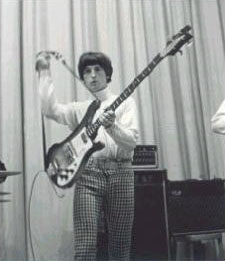 Peter Alexander Greenlaw "Pete" Quaife, a founding member of The Kinks who played bass with the band until 1969, died on 23 June at age 66 in Herlev, Denmark of kidney failure.




 Dublin, 16 June 1904.
 Posts
Posts


