SiteMeter

Showing posts with label the band. Show all posts

12 November 2010

All-Star Lineup To Discuss Dylan & The Band

New York's 14th Street Y has announced a symposium entitled "Bob Dylan & The Band: What Kind of Love Is This?" to be held on 5 December. The six and a half hour talkfest features an all-star lineup of noted Dylanologists:

Greil Marcus: Author of the definitive book on Bob Dylan and The Band, Invisible Republic: Bob Dylan's Basement Tapes.

Christopher Ricks: Renowned critic and scholar of English literature and poetry, and author of Dylan’s Visions of Sin.

John Niven: Novelist whose book Music from Big Pink vividly imagines the world of Bob Dylan and The Band.

Dana Spiotta: Author of mesmerizing portraits of the 60’s underground, including Eat the Document.

Matt Friedberger: Co-founder of the visionary rock band The Fiery Furnaces.

D.A. Pennebaker: Pioneering film documentarian, whose credits include Don’t Look Back, the first film on Bob Dylan.

Stephen Hazan Arnoff: Executive Director of the 14th Street Y writes and teaches widely on music, art and religion.

Wesley Stace (John Wesley Harding): Singer-songwriter and award winning author of Misfortune.

William G. Scheele: Museum curator and former Equipment/Stage Manager for Bob Dylan and The Band.

The program of events kicks off on 3 December with the gallery showing of some of Scheele's photographs of Dylan and his mates from 1973-1975. It concludes with a concert on 5 December following the roundtable, with musicians including Laura Cantrell, John Wesley Harding, John Medeski, Jolie Holland and others.

Tickets for the symposium and concert are $75 per (or $35 per if you just want to go to the concert) and can be purchased here.

02 November 2010

Your Weekly Dylan Cover [#23]


"Quinn The Eskimo (The Mighty Quinn)"
Manfred Mann
Original Dylan version found on Self-Portrait (1970)

Manfred Mann, a British band steeped in beat and blues, made its bones on the charts with "Do Wah Diddy Diddy," an Ellie Greenwich and Jeff Barry song that spent two weeks at #1 in the US in 1964. The group then became Dylan cover specialists, recording "With God On Our Side," "If You Gotta Go, Go Now" and "Just Like A Woman."

Then came "Quinn The Eskimo (The Mighty Quinn)." The Night Owl's initial exposure to this Dylan composition was like, I suppose, the majority of listeners: this Manfred Mann cover climbed to the Top 10 back in February 1968. The catchy tune, a nursery rhyme that leans musically on (of all things) a flute hook, naturally caught the attention of this then nine year old listening to nascent AM rock and roll radio.

=========================

The genesis of "Quinn" is Dylan's famous sessions with The Band in Woodstock, New York back in 1967. That demo was not intended for release, but first surfaced on the bootleg Great White Wonder in 1969. A live take of the song - apparently from the Isle of Wight Festival - first appeared commercially on Self-Portrait (1970) and then once again on Greatest Hits Vol. II (1971). The second take from Woodstock was included on the seminal collection Biograph (1985). Ironically enough, when the bootleg finally reached the light of day on Columbia's double-disc The Basement Tapes (1975), "The Mighty Quinn" was not on the 24-track listing.

Dylan amusingly refers to "The Mighty Quinn" in a chapter of his memoir Chronicles (p. 187):

On the way back to the house [in New Orleans] I passed the local movie theater on Prytania Street, where The Mighty Quinn was showing. Years earlier I had written a song called "The Mighty Quinn" which was a hit in England, and I wondered what the movie was about. Eventually I'd sneak off and go there to see it. It was a mystery, suspense, Jamaican thriller with Denzel Washington as the mighty Xavier Quinn, a detective who solves crimes. Funny, that's just the way I imagined him when I wrote the song "The Mighty Quinn." Denzel Washington. He must have been a fan of mine . . . years later he would play the boxer Hurricane Carter, someone else I wrote a song about. I wondered if Denzel could play Woody Guthrie. In my dimension of reality, he certainly could have.


07 August 2010

The Dictionary of Soul: Henry Glover


The great thing about being a rock and roll is the new names that are discovered inadvertently when researching something seemingly different. TNOP knew the bare bones biography of Henry Glover (1921 - 1991): a producer, arranger and talent scout for King Records, also an important figure in the desegregation of music in the late 1940s and into the 1950s.

A native of Hot Springs, Arkansas, Glover was exposed to a variety of music as a youth and became a trumpet player. After attending high school and college, he played in the Buddy Johnson and Lucky Millender big bands in the mid-1940s. His appointment with fate was meeting Syd Nathan, a record shop owner turned independent label mogul from Cincinnati, Ohio. Nathan's King Records became famous for signing and releasing numerous hits by James Brown, Hank Ballard and other R&B greats.

Glover's knowledge of jump blues and rhythm and blues was invaluable to Nathan, and led him to a land pioneering management position for a black man in the music business at the time. While at King, Glover produced some of the most important early R&B sides that would forever influence rock and roll: Little Willie John's "Fever"; Hank Ballard's "Annie Had A Baby"; and Bill Doggett's "Honky Tonk".

After leaving King in 1958 to join Roulette Records, Glover worked with Sarah Vaughn, Dinah Washington, Sonny Stitt and Ronnie Hawkins. The latter would prove important as he became an early backer of Hawkins' backup band, The Hawks, who would later famously back up Bob Dylan and then leave a music imprint of their own on rock history as The Band.

But what took us by surprise was the number of noted hits that Glover penned himself. The four that TNOP appreciate the most are all very diverse in sound and style. They all belong in our Ultimate Singles Jukebox, and we hope that you enjoy listening to and reading about them in the coming days.

28 June 2010

Your Weekly Dylan Cover [#9]


"When I Paint My Masterpiece"
Elliott Smith
Original Dylan version found on Bob Dylan's Greatest Hits, Vol. 2 (1971)

Steven Paul "Elliott" Smith often expressed an admiration for Bob Dylan. Asked about early musical influences, Smith commented: "Probably the Beatles, and then Dylan. My father taught me how to play 'Don't Think Twice, It's All Right.' I love Dylan's words, but even more than that, I love the fact that he loves words. That's my favorite thing with him. Sometimes we play 'When I Paint My Masterpiece' in concert." (He also played "Don't Think Twice, It's All Right," dedicated to his father in some performances; and, in Minneapolis, Elliott played "Ballad of A Thin Man" in an October 1998 concert. )

"I like folk songs but it is a very defined genre and I think it's not really what I play," said Smith. "For me, the difference between folk and pop is that in folk there is a clear message in every song and there is usually a moral to the story. That's fine but it's not how I write. I like more 'impressionistic' things, word pastings. Pop is broader, more things can be in it together."

His simple take on "When I Paint My Masterpiece" above is from an impromptu performance at Boston's Newbury Comics on 5 October 1998.

Elliott Smith would appear on Saturday Night Live 12 days later. And despite having been nominated for an Academy Award and solid album successes Either/Or, XO and Figure 8, Smith - plagued by harrowing mental illness most of his life - would be dead less than five years later.

======================================

I remember receiving Bob Dylan's Greatest Hits, Vol. 2 for Christmas in 1971 on a new fangled format: cassette tape. Two LPs could fit on one compact cartridge! The player that I had was the equivalent of a cassette "Close 'N Play": an orange plastic contraption with one tin speaker, an exposed area to pop in the tape and a single pushdown bar to start or stop the music (yep - no rewind, forward or record, just the Neanderthal basics).

The new Dylan songs were the curiosity on Vol. 2. One of the new originals, "When I Paint My Masterpiece," immediately starts abruptly following applause from the 1963 Town Hall live recording of "Tomorrow Is A Long Time." The tune is another playful Dylan ramble, indirectly commenting on the pleasures and bothers of the road for a particular musician. It is one of two songs on the LP produced by the under-appreciated Leon Russell, who was starting to make his mark with both Joe Cocker (Mad Dogs & Englishmen) and as a solo artist (Leon Russell & The Shelter People).

Original Listening: Bob Dylan, "When I Paint My Masterpiece"

Other Cover Version: The Band, "When I Paint My Masterpiece" (Cahoots, 1971)

09 June 2010

Your Weekly Dylan Cover (#7)


"Forever Young"
Liam O Maonlai with The Swell Season
Original Dylan version found on Planet Waves (1974)

Thanks to our friend Bird, we discovered this little gem, recorded for Czech Republic television back in 2008. Marketa Irglova, a native of that Eastern European nation and half of The Swell Season with Glen Hansard, are joined by Liam O Maonlai, former lead singer of Hothouse Flowers.

It is O Maonlai who shines on this take of Dylan's "Forever Young," leading the melody both on piano and by building his voice verse by verse to the point of exuberance. Hansard keeps up on guitar and subtly compliments the end of each stanza with a gentle backing vocal; it is evident that these fellow Dubliners have played together on Grafton Street or in pubs before.

Irglova and Hansard look at each other a few times as if saying, "this is really something special." It is.

===========================================

There are two versions of "Forever Young" on the 1974 release Planet Waves, bridging Sides One and Two. While the song is now a long-time Dylan standard, it did not make much of a ripple upon its release, and neither, surprisingly, did the album. This in and of itself was very curious, for the pairing with The Band - now stars in their own right - with old mentor Dylan , and a pending tour (memorialized on Before The Flood) should have been a home run. Maybe it was the malaise that was setting into the bloated rock world, only to be reinvigorated a couple years later by the punk movement. Maybe it was the odd fact that the LP label looked weird on the turntable (Dylan had defected to David Geffen's Asylum Records, after nearly fifteen years with titan Columbia Records). Or maybe it was the hodgepodge of song selection (Bill Wyman called it "a spare but twisted collection of songs").

In retrospect, "Forever Young" is the most enduring and strongest selection off Planet Waves. Its waltz melody perfectly accents the Psalm-like recitation of wishes that all parents have for their children. In one of the rare direct references to his songs, Dylan said: "I wrote it thinking about one of my boys and not trying to be too sentimental."

Original Listening: Bob Dylan, "Forever Young"

Live Listening & Viewing: Bob Dylan & The Band, "Forever Young" (The Last Waltz, 1975)

Alternate Take: Bob Dylan, "Forever Young" (Biograph, 1985)

Other Cover Versions:

Eddie Vedder, "Forever Young" (Boston, 2006)

Neil Young & The Grateful Dead, "Forever Young" (San Francisco, 1991)

03 March 2010

The Morning Papers


TNOP brings the news to your front doorstep . . .

NPR Music is streaming the new Gorillaz album, Plastic Beach. We're a couple of spins through and its true to the groove. While there doesn't appear to be a song like "Feel Good Inc." or "Clint Eastwood" that immediately catches the ear, the Lou Reed tune, "Some Kind of Nature," is especially cool. And you can also check out 2D, Murdoc and Noodles being pursued by Bruce Willis in the video for the first single, "Stylo." Where's Russel? Stay tuned.

On May 18, Universal Music will reissue one of the most critically acclaimed rock records of all time, The Rolling Stones' Exile On Main Street. The new package will include four never heard tunes produced by Jimmy Miller, Don Was and The Glimmer Twins (Mick & Keef).

Brooklyn's Yeasayer played Brighton Digital in the UK on Monday night. The Guardian reviews.

Clarence Greenwood a/k/a Citizen Cope talks with Jim DeRogatis in advance of his sold-out show in Chicago this coming Friday at The Vic.

The Morning Benders, a three piece outfit from Berkeley, California, have warmed up for some significant indie acts (Grizzly Bear, The Kooks and Ra Ra Riot, to name a few) over the past couple of years. Now they may be on the verge of breaking out with their pending CD Big Echo. You can stream the whole album over at Muzzle of Bees. And the band lets you download their Phil Spector Wall of Sound influenced opening track, "Excuses," for free at their website.

Baltimore pop duo Beach House celebrate their latest release Teen Dream with an interview and mini-set on the World Cafe.

This Saturday night The Avett Brothers play a sold-out gig at The Riverside in Milwaukee. No tickets? Hear the show live on 88Nine Radio Milwaukee.

If you've been a reader of this blog, you know our affinity for soul giant Bill Withers. Now the latest issue of The New Yorker profiles him.

Canadian folk legend Gordon Lightfoot submits to a Q&A with Connect Savannah.

The Choice Music Prize is Ireland's annual bow to the best pop music on the Emerald Isle. The Irish Times gives us a run-down on all the nominees and sets the odds of winning, as well.

Finally, The Band's multi-instrumentalist and vocalist Richard Manuel passed away 15 years ago today. In gracious memory of his extraordinary talent, listen to his lead on "Tears of Rage" at Woodstock in 1969. The footage is rare and quite coarse, but it's worth it. As Levon Helm put it, ". . . once he got started, man: drums, piano, play it all, sing, do a lead in one of them high, hard-assed keys to sing in. Richard just knew how a song was supposed to go. Structure, melody; he understood it."

19 January 2010

Ultimate Singles Jukebox [Slots 109 & 110]

Robert "Bobby" Charles Guidry, a native Cajun of Louisiana, died this past week at the age of 71. Known professionally as Bobby Charles, he wrote many popular songs, including "See You Later, Alligator," one of the first big hits in the new rock genre, and a paean to his musical center, "Walking To New Orleans." Charles was a performer in his own right (the first white artist signed to the famous Chicago blues label Chess), and counted a number of rock's elite as his friends, including Bob Dylan and Willie Nelson. But his public persona was a very guarded one; while he sang with The Band in The Last Waltz, his appearances were few and far between. In addition, his recorded output was only occasional. But Homemade Songs, a 15-track album of originals recorded last year with pals Spooner Oldham and Dr. John, was released in May 2008. The liner notes were provided by none other than Dylan: “He was more successful as a songwriter than a singer. And it’s a sin ’cause he’s a hell of a singer. He’s got one of the most melodious voices ever transferred to vinyl. The boy could sing like a bird — he still does.”


TRIBUTE: The New Orleans Times-Picayune provides an excellent tribute to Bobby Charles upon his death on 14 January 2010.


ESSENTIAL LISTENING: Last Train To Memphis (Rice 'n Gravy Records, 2003) - an excellent two-CD collection of twenty years worth of Charles' best songs, with notable musicians on hand to help out. Bobby Charles (Bearsville, 1972) - called the "lost album by The Band" because the group served as backup to Charles, it is highly recommended (find it on iTunes).

=============================================

See You Later, Alligator
Bill Haley & His Comets
Written by Robert Charles Guidry
Produced by Milt Gabler
Decca Records 29791
Released 1 February 1956

The music revolution was here. Some knew it, others didn't. Elvis smashed through the square barrier, but other musicians maintained the traditional look and surreptitiously advanced the cause. In 1954, Bill Haley & His Comets recorded and released arguably the most important record in rock and roll history: "Rock Around The Clock." Throughout the rest of that year and 1955, the group had a series of Top 10 hits (most notably a remake of Big Joe Turner's "Shake, Rattle & Roll").

In February 1956, Haley struck again, this time with a song by a young New Orleans based
writer and erstwhile performer named Bobby Charles. "See You Later, Alligator" was a phrase that Charles accidentally tripped upon and incorporated into a tune. Almost overnight, teenagers went mad for it, and were dancing in the aisles in movie theaters when Bill Haley & His Comets were featured singing an up tempo "Alligator" in the film The Blackboard Jungle.

Listen and watch Bill Haley & His Comets perform "See You Later, Alligator" from the 1956 movie The Blackboard Jungle.

Walking To New Orleans
Fats Domino
Written by Antoine Domino & Bobby Charles
Imperial Records
Released 1960

Antoine Dominique "Fats" Domino (born in New Orleans, 1928) is, without a doubt, one of the most important figures in the history of rock and roll. He began playing piano for change outside honky tonks in New Orleans, and quit school at 14 to pursue a musical career in the evenings while holding a day job at a bed-spring factory.

Domino was discovered by bandleader Dave Bartholomew and had his first of a string of hits in 1949 with "The Fat Man." Over the next ten years, he would sell 65 million records, second only to Elvis Presley. One of those hits was a tribute to his hometown written with Bobby Charles, "Walking To New Orleans."

Watch Fats Domino and his unique rolling piano style in a live performance of "Walking To New Orleans."

25 November 2009

This Date In Rock History: 25 November


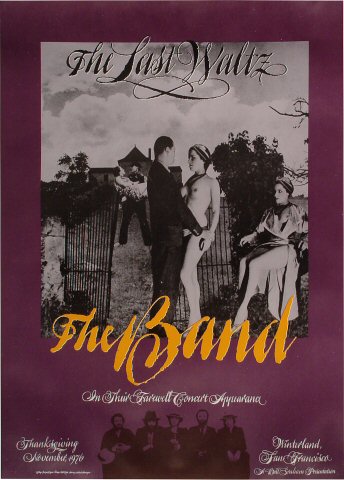
On this date in 1976, The Band played its last concert as an original quintet. Now famously known as "The Last Waltz" (original concert poster pictured above), the show took place at Bill Graham's Winterland Ballroom, an old ice skating rink located in San Francisco's Pacific Heights neighborhood. Immortalized in the Martin Scorsese documentary, The Band was joined by a Who's Who of the music world at the time.

Just in time for the 33rd anniversary and holiday listening, Wolfgang's Vault is streaming the entire, four hour show unedited for the first time! (Note: Listening is free, but you must register simply with e-mail address and password.) So, as Van The Man says, turn up your radio.

SET LIST (Links are to video performances from the film)
Shape I'm In
Life Is A Carnival
This Wheel's On Fire
W.S. Walcott Medicine Show
Georgia On My Mind
Ophelia
King Harvest (Has Surely Come)
Stage Fright
Rag Mama Rag
Intro/Who Do You Love (with Ronnie Hawkins)
Such A Night (With Dr. John)
Down South In New Orleans (with Dr. John)
Mystery Train (with Paul Butterfield)
Caledonia (with Muddy Waters)
All Our Past Times (with Eric Clapton)
Further On Up The Road (with Eric Clapton)
Four Strong Winds (with Neil Young)
Shadows and Light (with Joni Mitchell)
Furry Sings The Blues (with Joni Mitchell)
Dry Your Eyes (with Neil Diamond)
Tura Lura Lural (with Van Morrison)
Acadian Driftwood (with Joni Mitchell and Neil Young)
Genetic Method
Chest Fever
The Last Waltz Suite: Evangeline
Baby, Let Me Follow You Down (with Bob Dylan)
Hazel (with Bob Dylan)
I Don't Believe You (She Acts Like We Never Have Met (with Bob Dylan)
Baby, Let Me Follow You Down (reprise) (with Bob Dylan)
Instrumental Jam #1
Instrumental Jam #2
===================================================
The Band: Rick Danko - bass, fiddle, vocals; Levon Helm - drums, mandolin, vocals; Garth Hudson - organ, piano, accordion, synthesizers, soprano saxophone, violin; Richard Manuel - piano, organ, drums, clavinet, dobro, vocals; Robbie Robertson - guitar, piano, vocals

Horn Section: Richard Cooper - trumpet, flugelhorn; James Gordon - flute, tenor saxophone, clarinet; Jerry Hay - trumpet, flugelhorn; Howard Johnson - tuba, baritone saxophone, flugelhorn, bass clarinet; Charlie Keagle - clarinet, flute, saxophone; Tom Malone - trombone, euphonium, alto flute

17 November 2009

This Date In Rock History: 17 November


Happy birthday to film director Martin Scorsese. But rock 'n roll, you ask? Absolutely: check out the ever-present soundtrack running in the background of Goodfellas and Casino. More importantly, Scorsese (shown with The Band's Robbie Robertson, above) has turned out to be one of the more influential figures in rock documentaries. He was a young camera operator and editor on Woodstock. He chronicled The Band's swan song with an incomparable guest list at San Francisco's Winterland Ballroom back in November 1976, resulting in The Last Waltz. In recent years, Scorsese has tackled the rise of Bob Dylan in No Direction Home as well as the career of The Rolling Stones in Shine A Light. A bio-pic on Frank Sinatra and a documentary on George Harrison are now in the works.