[The following entry was contributed by TNOP's County Clare correspondent, Celtic Ray.]
The Co. Waterford band O Emperor has burst on to the Irish music scene with the release of its first long-player, Hither, Thither. In between gigs around the island - including appearances at Oxygen and Electric Picnic - the band has spent the better part of the last year writing and recording the LP in a drafty country house. The results are quite impressive: the five piece group drifts among many styles, utilizing a number of instruments in their arsenal.
"Sedalia" is a dreamy, Beatlesque ballad, showing off the gorgeous vocals of Paul Savage and the piano of Philip Christie. The narrator is a weary follower in a relationship, realizing how the passage of time has robbed him of forward promise.
O Emperor freely admits to a Radiohead influence, and it is on prominent display in the first single and album opener, "Po":
Another highlight is "Don't Mind Me," which takes this writer back to the Fleetwood Mac days of the 1970s (pre-Buckingham/Nicks). This take of the swaying tune at Limerick Live on Cruises Street from February shows off the versatility of O Emperor. The boys have been playing together since they were 17, and it shows with this tight performance (thanks to Indie Limerick for the video):
O Emperor's multi-faceted sound combined with thoughtful lyrics make them a band on the come. Beware of a breakout in the coming months.
On this date in 1936, Charles Hardin Holley was born in Lubbock, Texas to Lawrence and Ella Holley. He would have been 74 years old today, had he not gone a-way.
Known always as "Buddy" to his parents and two older brothers, he learned to play various string instruments at an early age from them and starting singing with a junior high school friend at clubs and talent shows.
By the time Buddy was 19, he opened for Elvis Presley and Bill Haley & His Comets when the two stopped in Lubbock for concert appearances. Merging rockabilly with Chet Atkins style guitar, Buddy's unique "hiccup" vocals earned him a trip to Nashville. There he recorded some sides with his band The Crickets (Jerry Allison - drums; Joe B. Maudlin - bass; Niki Sullivan - guitar) for legendary producer Owen Bradley. A couple of those sessions resulted in a few sides released on Decca, and went nowhere. Decca didn't pick up a option to keep him on the label.
But agent and producer Norman Petty saw the potential in Holly and his mates. They recorded material in a more up-beat fashion in Clovis, New Mexico. Out of those sessions came the smash "That'll Be The Day" and "Peggy Sue," both of which were performed by Buddy Holly & The Crickets on The Ed Sullivan Show on 1 December 1957.
Most of you know the rest of the story, including the tragic plane crash that took the 22-year old Holly's life in 1959. But it is always worth mentioning the massive influence he has had on rock and roll history.
It wasn't just Elvis that helped bridge the divide between black rhythm and blues and white based country and swing. Buddy Holly & The Crickets eventually won over the tough audiences at Harlem's Apollo Theater, the only white group playing with pioneers Chuck Berry and Little Richard.
Forty years after Holly's death, Bob Dylan reminisced at the 1998 Grammy Awards in an acceptance speech about seeing The Crickets as a youth: "And I just want to say that when I was sixteen or seventeen years old, I went to see Buddy Holly play at Duluth National Guard Armory and I was three feet away from him...and he looked at me. And I just have some sort of feeling that he was — I don't know how or why — but I know he was with us all the time we were making this record in some kind of way."
The Beatles didn't just name their group as a nod of respect to The Crickets. The Fab Four regularly covered Holly in their days apprenticing in England and Germany. They also recorded "Words of Love" and "Mailman, Bring Me No More Blues." Paul McCartney holds the rights to the Buddy Holly song catalogue. George Harrison saw Holly as a youth and patterned his rockabilly style guitar licks after many of his recordings. John Lennon recorded "Peggy Sue" on his Rock 'n Roll covers album.
Keith Richards openly has discussed his admiration for Buddy Holly. He has been quoted as saying he too attended a Holly performance in London, where he heard "Not Fade Away" for the first time. The Rolling Stones' bone-shaking version of that song - itself a deep bow by Holly to Bo Diddley - is the classic version in the Holly covers canon.
Bruce Springsteen told Dave Marsh in 1978 that "I play Buddy Holly every night before I go on; that keeps me honest." The Boss has covered Holly on stage numerous times, including takes on "Not Fade Away" and "Rave On."
Among the luminaries at the U.S. President's residence for the Macca fete was Jack White. Last year, the White Stripes/Raconteurs/Dead Weather member revealed his fondness for The Cute One. "Paul is my favorite Beatle," the guitarist told MTV News backstage at the Outside Lands Festival. "He's been a big influence on me — especially the way that he sings."
White cited an early track as the point of inspiration for his Paul admiration. "I heard a cover song they did early on called 'Hippy Hippy Shake' (from Live At The BBC) that Paul sang, and I loved how high he sang it," White said. "My voice isn't comfortable in that higher range, but that song was a big influence on me trying to get my voice somewhere like that."
On June 2 at The White House, Jack White strapped on an acoustic guitar and treated the Leader of the Free World and the rest of the audience to The White Album track "Mother Nature's Son" - and for good measure threw in a few bars of "That Would Be Something" from McCartney's first solo album.
"Mama, You Been On My Mind" Jeff Buckley Original Dylan version recorded during Bringing It All Back Home sessions (1965); studio recording first officially available on The Bootleg Series, Vols 1-3 (1991)
Jeffrey Scott Buckley was born in Anaheim, California in 1966, the only son of musicians Tim Buckley and Mary Guibert. Tim Buckley won critical notoriety for his folk albums in the 1960s, but died of a drug overdose in 1975. Young Jeff recounted that his sole encounter with his father was when he was eight years old.
Nevertheless, Jeff was surrounded by music as he grew up and was attracted to the guitar. After graduating high school, he formally trained for a year at the Musicians Institute in Hollywood. For the ensuing decade, Buckley made a living as a side musician in the Los Angeles area, and then in New York City.
In 1991, Buckley took part in a tribute to his father at St. Ann's Church in Brooklyn. Singing a quartet of songs, he saw this opportunity as a way to honor his absentee father's memory.
Buckley then started to make a name for himself in small clubs in New York, particularly the Sin-e, where he became the house act, mostly performing covers of a diverse array of artists, including Van Morrison, The Smiths, Leonard Cohen, Led Zeppelin, Bob Dylan and Nusrat Fateh Ali Khan. He also began writing original songs with Gary Lucas.
Creating a buzz in the musical community, record execs started to court Buckley. In 1992, the singer-songwriter signed a three album deal with Columbia Records. The first, Live at Sin-e, was released in 1993. But it was the next long-player in August 1994, Grace, that became a critical smash.
Jeff Buckley tragically drowned in the Wolf River near Memphis, Tennessee on 29 May 1997. He had been living in the city, working on a new album.
In 2004, in honor of the tenth anniversary of Grace, Columbia released the "Legacy Edition," a two CD set including a number of covers. It is from this compilation that Buckley's version of Bob Dylan's "Mama, You Been On My Mind" is culled.
Dylan recorded this song during the Bringing It All Back Home sessions back in 1965, but the understated studio recording was not officially released on record until 1991 on The Bootleg Series (Vol. 1-3). It is classic Dylan, with a simple melody and chord structure that lends itself to interpretation by other artists.
Buckley, in particular, makes it his own. At times simulating Dylan's chords with his spare electric guitar, his fantastic voice embodies the lyrics. It is amazing how mature Dylan's poetry was at this early stage of his career; via Buckley, the words have emotional heft whether one envisions the narrator pining for his lost lover after a separation of one year or twenty.
In an interview with Now magazine back in 1998, Buckley's mother Mary Guibert concluded her talk with Kim Hughes as follows:
"And you know," she offers, her composure finally crumbling, "Even Bob Dylan, in an interview with a French magazine, named Jeff as one of the great songwriters of this decade." Guibert, for the first time, begins to weep. "I don't think you can find any higher praise than from the lips of that gentleman."
The Financial Times of London reports that music giant EMI is seeking to sell maybe the most famous studio in the world: Abbey Road. The site of many noted recordings, Abbey Road Studios is housed in an 1831 Georgian townhouse located in the St. John's Wood neighborhood of London. Of course, no work produced there is known to rock 'n roll fans more than the Beatles' final album, titled in 1969 for the place where they made 90% of their wax works.
The BBC interviewed Sir Paul McCartney this evening, who provided these comments: "There are a few people who have been associated with the studio for a long time who were talking about mounting some bid to save it. I sympathise with them. I hope they can do something, it'd be great. I have got so many memories there with the Beatles. It still is a great studio. So it would be lovely if somebody could get a thing together to save it."
Abbey Road's studios came into use when EMI bought the place and refurbished it back in 1931. Because the studio is large enough to fit a symphony orchestra, the space has been popular over the years for the recording countless film scores, including The Lord of the Rings and Harry Potter, as well as some of the more noted orchestras throughout the world.
In addition to the Beatles eponymous album, whose cover of the Fabs made the street crossing in front of the studio an iconic image, these revered works were also made: Pink Floyd's Dark Side of the Moon; The Alan Parsons Project's I, Robot; and Radiohead's The Bends.
On 25 June 1967, the first worldwide television satellite broadcast originated from Studio Two at Abbey Road. The Beatles sang "All You Need Is Love" in an effort to promote world peace. Viewed by 400 million people in 26 countries, the telecast was in black and white, later to be colorized by the Beatles in their documentary Anthology (that's producer George Martin in the booth at the beginning of the clip; watch for Mick Jagger in the audience, as well):
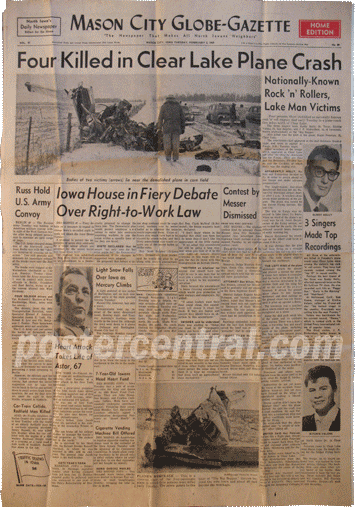
Fifty-one years ago today, in Clear Lake, Iowa, rock and roll lost three of its pioneering artists in a plane crash. Perishing in a cornfield in the dead of winter were Texan Buddy Holly, Californian Ritchie Valens and DJ J.P. "The Big Bopper" Richardson, along with pilot Roger Peterson. All three singers were riding the crest of a wave of music popularity.
Holly, who had already established a solid career at the young age of 22 with hits like "Not Fade Away," "Peggy Sue" and "Rave On," would become hugely influential in the careers of The Beatles and The Rolling Stones, among many others.
Buddy Holly & The Crickets, "Peggy Sue" (1957)
Buddy Holly interview with Red Robinson, Vancouver, October 23, 1957.
Valens, born Richard Valenzuela, was only 17 at the time, and had broken out with the rocking "Come On, Let's Go" and then topped the charts with the ballad "Donna." The teen would later be immortalized in the movie La Bamba and his music would again be brought to the masses by Los Lobos.
Ritchie Valens, "Donna" (live recording 1958)
Richardson, from Texas, had a novelty record called "Chantilly Lace" that gathered attention. What most do not know is that he was also the author of "White Lightning," a tune George Jones took to the top of the charts after the crash.
The famous odd-man out on the fatal plane ride? Waylon Jennings, whose playful comments with Holly about the cold and its potential effects on their respective means of transportation would haunt him until his death in 2002.
FURTHER LISTENING AND VIEWING: The Rolling Stones perform Buddy Holly's "Not Fade Away" in a 1964 television appearance:
In the aftermath of one of the most traumatic events in American history, Capitol Records unwittingly lit a spark that would provide a healing balm in the matter of a couple of months. On this date in 1963, The Beatles' first U.S. single was released, the double-sided monster pairing of "I Want To Hold Your Hand" and "I Saw Her Standing There." Both written by John Lennon and Paul McCartney, the lads from Liverpool had vowed that they would not touch American soil until they had their first number one.
On February 1, 1964, the record hit the top of the charts and stayed there for seven consecutive weeks. (TNOP still has its 45 rpm copy in the archives.) And the music world was literally never the same.
"I Want To Hold Your Hand" remains the biggest selling single of The Beatles' career.
====================================== FURTHER VIEWING AND LISTENING:




 Posts
Posts


